Showing posts with label wool review. Show all posts

Thursday, November 12, 2020

Sock Yarn, v13

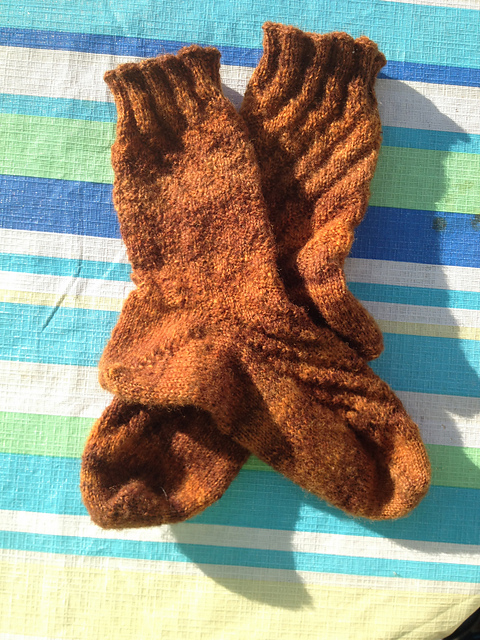
....aaaand more socks knit up....

1. Zwerger Garn Opal (uni colours) - a very popular European sock yarn that I only recently got my hands on; it's not easily available in my area so I resorted to online shopping. Comes in nice subdued plain colours and is the usual 400m/100g grist (ie. nice and thin). I find it harsher and splittier than my favorite Regia, but it isn't bad at all. It softens a bit in the laundry, and holds its shape admirably. So far (about a year) holding up well, no felting, pilling, or fading. ** update 2021 ** the pair of socks requires darning, multiple holes on the sole. Lasted just under 2 years....not very impressive!


2. West Yorkshire Spinners Signature 4 ply - purchased online, not locally available. It's got 35% BFL in it, which I thought would give it some lustre and also some longevity. Has some nice colours (I especially like the golden colour). However, the yarn has no shine, it's quite hairy in fact. A bit splitty to knit. What I dislike about this yarn, though, is the fact that as you wear the sock, it starts to bag - the body disappears. After a laundry cycle the sock is all nice and tight again, but during the day the socks slide down my leg. I won't use it again (for socks). 


Finally, an update on Drops Fabel, which I've now found a local source for. The upside of this yarn is it's nice colours and good price point, the downside is it is a bit thicker than I'd like. The ballband shows 410m/100g, but it feels a good deal thicker than this and the final sock just feels heavier. Wears well, maintains its colour and doesn't felt.

Saturday, April 28, 2018

Sock Yarn Review, v 12

1. KnitPicks Hawthorne - I used the "tonal handpaint" colourway. I was hoping that this yarn would be a "budget" version of Woolen Rabbit Pearl, and it some ways, it is that. At half the price, it certainly is "budget".... The yarn base is nice - not merino, so not as soft as Stroll - with a nice tight ply and lots of boing, so I find it pleasant to knit with. The dye job is not as nice as Woolen Rabbit - the colourways are not as subtle and it stripes in short sections. I think that it's probably not suitable for complex texture designs (like cables) because the colours are overpowering. I've seen other reviewers complain about excessive colour bleeding, but I have not had any issues. I will have to see how this yarn holds up in the long run.

2. Drops Fabel - this is a very popular European sock yarn that I have now finally found a local-ish source for. The colour selection is huge. It's superwash wool (not merino) at 410m/100g, and feels pretty close to Regia, although a little harsher and a bit splittier to knit with. It has an excellent price point! Again, will have to see how this holds up through the laundry.

3. H&W Comfort-Wolle sock wool (uni colours) - got this online from a retailer in Ontario; it's not a common yarn. But, very very nice, right up there with Regia. I'm pumped to see how this will handle repeated laundering; if it's good it will be a close contender to Regia!

4. Not sure if this qualifies as a sock yarn, but I've been knitting a project with KnitPicks Stroll Gradient. Yeah....no. Not something I'd knit socks with - the gradient isn't really a gradient - the colour changes are too abrupt. Also, some of the colours stripe/pool during parts of the "gradient". And then there's the fact that it's Stroll - a yarn I am starting to like less and less...

I have recently found an amazing online source for sock yarn: Wool Warehouse. This outfit is based in the UK but shipping to my front door is a flat-rate $CD7, which is f*&*ing cheap, folks! Not to mention that the yarn price is amazingly low! I looooove their selection of Y-chromosome friendly Euro sock yarns.

So, a few days ago, this showed up on my doorstep:

[a crapton of sock yarn, in a lovely organza bag!]

Love the yarn. Love the bag! Can't wait to get started!


Monday, December 11, 2017

Handspun Sock Showdown

Time for a re-examination of some of my better handspun socks. I'll let you guys see the "before-and-after" photos. These are all socks that have held up well after at least a year of heavy use. My other handspun socks have mostly felted and/or shrunk and/or worn faster these, so I won't be using those fibers again. Yes, that includes UK Southdown...it wears fast.

Number 1: UK superwash BFL / nylon (70/30) blend

The yarn was spun very fine - 4 ply - since at the time I was really trying to reproduce commercial sock yarn. The yarn felt quite nice - quite comparable to a millspun yarn although a little tighter plied. I didn't go out of my way to knit them tight. These socks are by far the best of my handspun socks, in terms of longevity. They haven't felted appreciably, and there has been no need to darn them. The dye has faded in the laundry, over time. I would highly recommend this blend for those who don't want to agonize overmuch about TPI, grist, or knitting gauge. In fact, I'd recommend this blend to myself. Self: please get more of this stuff.

[superwash BFL/nylon before]

[superwash BFL/nylon after -
note fading but stitch definition still good. 2.5 yrs old.]


Number 2: UK shetland / mohair (70/30) blend

The yarn is 3-ply and very dense, not very thin though - heavy fingering/light sport. The yarn is rather different to knit - it has very little elasticity, and I knit it supertight, so the resulting fabric is probably not what people are used to in a sock. They're a bit stiff, smooth, and rather slippery. That's the mohair talking! They are very, very warm and comfy though. The socks have been darned once (they wore through at the toe very quickly) but since then have been performing well. They have felted and shrunk a tiny bit. This is a good blend for those who eschew the use of nylon and superwash.

[shetland/mohair blend, before]

[...and after. Minimal fading. 1 yr old.]

[there is felting on the inside, on all my handspun socks, 
but much less on the superwash ones]

Both fibers from number 1 and number 2 socks came from Hilltop Cloud, a favorite indie fiber dyer of mine. I'm pretty sure she uses UK-sourced fiber. She does not always carry sock blends. I love her sense of colour, and I keep an eye on her shop so I can order from her when she does carry my favorite blends.

Number 3: local Romney, 100% pure wool

The fiber is local, not UK Romney, and was pindrafted roving (not combed top), so these are true woolen spun socks (for those purists out there). Like the socks above, the yarn was dense, and I knit them at a tight gauge, so the socks were not as elastic as you'd get from a commercial sock yarn, but they were super warm. I loved them!! They were tough as nails, but now have started to wear out at the heel, and have been darned twice at the toe. They currently reside in my darning basket...

[local romney, before]

[...and after. 2 yrs old. Note fading and pilling, 
and you can see the darning spot on the heel...]

[...with more required!]

That gives me a pretty good choice of sock fibers to pick from! 

Of course, I'm still trying other fibers and blends...the fun never stops!


Monday, November 13, 2017

How Do I Love Thee, Zauberball?

OK. Total disclosure: I DO NOT GET PAID BY ANYONE TO DO YARN REVIEWS.

There, now that that is out of the way, I can wax lyrical about one of my favorite yarns: Schoppel Zauberball Crazy. And if Schoppel would now like to send me some yarn love, I won't complain ;)

Zauberball is Euro-style sock yarn, 25% nylon/75% wool, thin (420m/100g), 2 ply and non-merino. It is not soft, but has a high price point all the same. Lots of knitters don't like this yarn because for the price they want soft. If you are into "soft",  this yarn will disappoint.

Thanks to the zero merino content, though, it wears quite well - no felting or pilling. I did, however, have a pair of Zauberball socks that wore through badly after about a year - holes in unexpected places all over the sole - though I suspect it was because my teenaged son was wearing the socks while longboarding - his shoes had holes in the same damn places as the socks!! Pro Tip: do not wear handknit socks when longboarding!

I've found that some of the dyes will fade over repeated laundry cycles, some colourways more than others. Since socks get washed a lot, it helps to be gentle with the detergent you use, if at all possible. I have had one colourway (2100 "domino") - which is starkly black and white - fade and bleed quite quickly, with all the white bits going grey. It seems to me that the bright colourways fade more quickly. But in general they look good for at least a couple of years.

Zauberball is a self-striping yarn with a very long colour change, and every ball is slightly different, so you are not going to be able to easily create identical socks using it. If you are a stickler for matching socks, this yarn isn't going to make you happy. But it's that same quality that makes it most excellent for "fun with colour". This is where this yarn really comes into its glory! Below I show you some of the socks I have knit using it, for your viewing pleasure. I've noted the colourways and patterns on the photos.

It's important to note that to get the look created in these photos, I wind the skein into smaller balls (at least 2 per sock so 4 smaller balls if I do 2AAT) and then use alternating balls for the (horizontal or vertical) stripes, or the wedges. This enhances the contrast between the stripes. The only socks where I didn't do this were the Zarathustra socks below - those display the natural colour rhythm of the skein, the contrast being provided by the plain grey of the Regia.

[pattern: Cookie A's Wedge sock, 
Zauberball Crazy colourway 3136 "der lenz ist da"]


[pattern: 2x2 colourwork using 2 ends of the ball, 
garter toes and FishLipsKiss heel,
Zauberball Crazy colourway 1564 "frische fische"]


[pattern: 2x2 ribbing, 6-row stripes from 2 ends of the ball, 
my own afterthought heel; 
Zauberball Crazy colourway 2137 "wurzelsepp"]


[pattern: Cookie A's Wedge sock, 
Zauberball Crazy colourway 3136 "blasser schimmer"]


[pattern: Caoua Coffee's Zarathustra socks;
Zauberball Crazy colourway 2312  "piano bar" 
combined with plain grey from Regia]


[pattern: 2x2 sprialling colourwork using 2 ends of the ball, 
my own garter afterthought heel 
Zauberball Crazy colourway 2092  "my sweet side"]


[pattern: 2x2 ribbing, 6-row stripes from 2 ends of the ball, 
my own afterthought heel; 
Zauberball Crazy colourway 1564 "frische fische"]

Have fun, sock knitters!


Friday, October 20, 2017

Sock Wool Review 11

Huh. Three more to blog about!

1. Cherry Tree Hill Sockittome: nice and thin at around 400m/100g, and nice colours....but pricey. Mine came put up in 50g balls, so I got two. Sadly, it felt quite harsh knitting up, and kind of splitty, too. Sure didn't feel like merino!! I gifted the socks, so can't comment on the wear, but I don't think this will be a repeat for me. According to Ravelry, it's discontinued. I'm not crying over this one.

2. Aslan Trends Santa Fe kettle dyed - 85/15 merino/nylon sock yarn, comes in 50g hanks at 165m (if I can read the blurry label...). This is a bit thicker than I normally use (I got it as a gift), but it is tightly plied and has a great "boing" factor. Seems to wear well, although it does pill in the long run. I used it in a pair of mosaic socks, using a non-merino contrast yarn which I also used for the heels and toes, so hopefully that will cut down on the pilling and felting at least a little. As per usual, I wouldn't normally purchase merino yarn for socks...

3. Dynasty sock yarn - can't find this on the the Ravelry database! It's a new one - Chinese product - carried by my local Fabricland shop. Pretty limited solid colours (no earth tones and I find the stripey colourways hideous), 75/25 wool (not merino)/nylon, 170m/50g so a bit thicker on paper than what I'd normally use. But it certainly knits up much thinner than the Aslan Trends above! It's surprisingly pleasant to knit, feels like a thinner version of Kroy. It's got a good price point at $16/pair and if you're a Fabricland member you usually get 20% off (and maybe more if you wait for a sale). Good for a few pairs, until you get tired of the colours.

Monday, July 3, 2017

Blended Fiber for socks

Now that I have some experience with single-breed handspun socks, I'm starting to want to branch out into fiber blends. Since I have no ability to blend fibers myself, I'm always on the lookout for suppliers who can sell me sock-friendly blends. My first forays will be into single-breeds with either nylon or mohair for strength.

So far, I've spun up a 70/30 shetland/mohair blend (from the UK) that has become a pair of socks that I am very happy with. The spun yarn (3 ply) had a nice sheen, but no bounce. The socks were knit at tight gauge. They developed a hole at the toe (my big toenail is a veritable saw) rather quickly, and have been darned, but the rest of the sock is, so far, wearing admirably. Comparable to my Romney socks.

[Shetland/mohair socks]

I have also spun and ruined a pair of 70/30 Finn/nylon socks - these felted very quickly. So no more Finn for me.

I have, laying around, some 70/30 Southdown/nylon as well, that is still waiting to be turned into socks. Yes, yes, I will get around to you!

And, I should mention one of my earliest forays into spinning for socks, a 70/30 superwash BFL/nylon blend that became a pair of socks for my husband, which have lasted 2 years so far with no signs of wear. I'll have to do a post on these so you can have a closer look at them (compare new and 2-year old photos), because so far, these are the strongest handspun socks I've made.

But here are some purchases that I made that I now have regrets about:

[70/30 (non-superwash) BFL/nylon blend]

[70/30 BFL/mohair blend]

I purchased them via the internet based on a description alone, which, it turns out, isn't enough. 

It's hard to see (particularly difficult in the second photo), but these blends are not actually blended enough for use in socks. The fiber is meant for decorative items. When the dyer ordered their raw material (from World of Wool, I suspect), they requested only 1 blending pass, so that there are still very visible "ropes" of nylon (emerald green streaks in the upper photo) or mohair (deep yellow, shiny, wavy locks to the right of my thumb in the lower) in the tops. I am afraid that this is not going to even itself out during spinning, so that the yarn will not have an even distribution of nylon in it. While this might be nice for a shimmery shawl, I'm not convinced it's useful for hard-wearing socks...I'll have to make a shawl or something out of these two!

So, lesson learned: I need to be sure that the blending is thoroughly done, and this is something I need to ask about, if I cannot see the product!


Monday, June 19, 2017

Socktacular Experiment, vol 2

Right. So a while back, I purchased a bunch of single-breed fleece "tasters" - 50g each - to spin into socks.

I've done 5 of the 7 by now, and it has been an interesting spinning experience. Here's a summary shot:

[top to bottom: Clun Forest, Romney, Texel, Southdown, Suffolk]

For starters, you can see that the colour "white" is quite different for each breed. The whitest is the Texel, which is really quite blinding. The Romney has a distinct yellow cast and the other three are rather close together - a greyish white, compared to the Texel.

Just to recall: these are all commercially prepped rovings (ie. carded, not even pindrafted) from the same mill. These are all classified as "medium wools", ie. not fine and soft like merino. The mill does not provide a micron count.

Here are my spinning notes so far, in order of my spinning them. They were all spun longdraw, true woolen style.

No.1 : Texel
Man, springy stuff! The fluffiest yarn I have ever spun, and I'm not sure it's suitable for socks. It is very fine, a little nebby, and the result is exceedlingly woolly and lightweight. It's very white and has no lustre at all - chalky white. I'd love to make a sweater out of this, it would be like wearing a cloud!
The yarn is underplied, so will have to go back through again before I knit anything with it. 

[Texel, up close. You can see it has too little ply for sock-use]


No.2 : Suffolk
This is an official downs breed, and is again springy, but not as blindingly white as the Texel. It feels coarser.  The roving was less nebby than the Texel, so an easier spin. 

No.3 : Clun Forest
I busted out the spinning oil on this one, just for fun. The first two didn't really need it, but I wanted to see if using it made any difference. The answer: not really (although I have had situations where a little spinning oil really helped!). This breed is definitely the coarsest so far, and feels almost wiry. I wound up spinning it a little on the heavy side. 

No.4 : Southdown
Very fine fiber. It's finer than the Texel and softer. Also, much nebbier than the others so much more work to spin. I did not enjoy this much, it was a lot of work. And I'm not convinced it'll be good for socks, without nylon...

No. 5 : Romney
OK, this is totally different stuff from the fiber I've spun up (mostly from the UK). It's about the same coarseness as the Clun Forest, and not as springy as the others. It has a very distinct yellow cast to it.

[Romney, close-up]

The last two are a Cotswold and a Dorset, which will be on the wheel shortly. Thereafter, the knitting starts!! Stay tuned.

Wednesday, October 19, 2016

Icelandic Souvenirs, Part II

Well, this post has absolutely ZERO to do with socks. Or knitting, even.

You see, a year ago or so, I decided I needed a way to get rid of some stash. Like most knitters - and especially now that I am spinning, and a member of a fiber club, which ensures a steady input of wooly stuff - I have a seemingly endless supply of yarn.

I took a weaving class. Yes, I know, I used to be of the opinion that I'd never be caught weaving. My mother had a huge floor loom and at age 14 I helped her with it - once. The adolescent me was bored beyond belief. That's what I remember, anyways. But after visiting various friends who have small looms, I thought....well....maybe....

So, this weaving class. It was using a so-called "knitter's loom", which is a small "rigid heddle" loom (20" width of fabric, handles about 3m maximum length) that sits in your lap and uses knitting yarns. One day in, I was hooked. Bought the thing and took it home. This is a device that simply eats yarn. You can whack out a length of fabric in about 8 hours, a little longer if you do complicated patterning. But boy is it fast!!

So, I've been playing with this thing. It's a new toy, so of course I'm neglecting all my sock-projects to spend time with my new love.

Back to Iceland...I got some Lettlopi, which is the DK-ish version of the icelandic wool. I let myself be inspired by the colours of the Iceland landscape I remember from our hike along the Laugavegur trail:

[ Laugavegur Landscape ]

I ordered 3 colours: green, black, and light grey. The yarn is a double-ply construction, very lightly spun and plied, and then felted for strength, so it stands up fine in the loom. I didn't break any threads. The wool is hairy and has a tendency to stick to itself, so it's not the easiest thing to weave with, but quite do-able with only a little bit of patience required.

And then I made a scarf, with the simplest design possible - a random set of stripes in both length and width. I finished it by giving it a warm bath, followed by a quick spin in the dryer to get it to the "damp" stage, and then a hot steam iron and a prolonged and very, very stiff brush. This treatment fulled the wool ("fulled" = very slightly felted), and the brushing made it fuzzy, in the same way that I remember the lopapeysa sweaters were (in fact, the higher-end sweaters I saw in Reykjavik came with their own little brushes!). Speaking of lopapeysa sweaters, here's a fascinating article about them. They are a post-WW2 invention and have taken on almost mythical status.

The end product is very lightweight, fuzzy, and very warm. It is not soft - Icelandic wool is not a fine wool, it's tough as nails, like the sheep it comes from - but I find it quite pleasant to wear. I only get itchy from wool if I get too warm; in cold weather, even coarse wool around my neck doesn't bother me at all. Just lucky, I guess.

my Icelandic Memory Scarf ]

I'm super-pleased with this result! It deserves my Icelandic Badge of Approval!

[ souvenir badge ]

Thursday, September 8, 2016

Sock Fiber Disaster

Yup, I do make mistakes. But that's how you learn, right?

I got some Finn fiber blended with 20% nylon (trilobal, I think, which is a bit sparkly) via a Ravelry group that is interested in trying different sock blends. I dyed it up myself using an iDye packet and spun it up and knit up some nice manly blue socks. They fit well and the initial products were pleasant and my husband wore them to work.

[Finn/nylon socks]

Then I washed them. 

Disaster.

After a mere 3 cycles through my usual laundry routine - which is, as loyal readers know, involves a Euro front-loader, delicate cycle, cold water, and air drying - they are completely and totally felted. A ruined mass of wool.


[felted socks]

[close-up of felted knitting]

Finn is a fairly fine wool, and in retrospect I should've known this would not be a happy choice. It is great for felting. Ergo, it is not great for socks, unless you're after slippers, I guess...

Lesson learned. No more Finn for me.

Sunday, August 28, 2016

Where've I Been?

So it has been a while since I've posted! I've been on vacation, doing an epic trip through the scandinavian countries: Iceland, Denmark, Norway and Sweden. I tested out some handspun hiking socks, saw many woolly critters, visited museums loaded with folk knitting and assorted handicrafts, and purchased some materials for new projects! I'll be sharing bits and pieces here over the next few weeks.

But let's start with the results of some hiking sock tests. I have 2 pairs of handspun, handknit hiking socks:

[4-ply local Romney knit into hiking socks]

[...and these Southdown 4-ply ones, recently completed]

The orange Romney socks have been hiking before. The pink ones I finished right before this vacation. I knit them up to replace similar (blue) Southdown socks that got shredded on the Appalachian trail last fall. Those blue ones were my first-ever handspun socks, so I thought perhaps the problem was my spinning technique (the socks were not very uniform), and I so made a new pair. Anyways, these two pairs of socks went with me to scandinavia for some serious testing...

My family and I did a 6-day trek on the Laugavegur trail, which is among Iceland's most scenic. It was a "supported hike" and we hiked about 15km per day with day packs (so, lightly loaded) on pretty mountainous terrain (through some amazingly spectacular scenery: if you like to hike, I can recommend this trek), but with excellent trails. Then, while in Norway, we did an 8-day trek through the Hardangervidda. This tour was from hut to hut, and food was supplied, but we did have to carry all our clothing - so I was more heavily loaded than in Iceland. The terrain, while flat, was much more uneven and wetter than in Iceland, which made for very exhausting days and a lot more strain on the feet. I certainly felt them much more on this trip!

I wore each pair of hiking socks for 3-4 days, and then switched to the other pair. (They did get washed between the two hikes.) This sounds gross, but in fact pure wool socks are pretty good about repelling odours. My socks did not stink! My feet stayed warm and dry; not sweaty. I got zero blisters. Both handspun pairs provided excellent cushioning; I did a test day just in the city with a pair of Asivik trekking socks that I purchased in Denmark, and these were nowhere near as comfortable (far less cushioning).


[Asivik brand trekking socks]

OK, so the results:

Both pairs developed holes. The Romney ones after the last day in Norway - so after a ton of abuse - but the Southdown pair after a mere 3 days of hiking in Iceland. I had to darn them basically right away! In other words, the Romney socks outlasted the Southdowns by about a factor of 3, taking into account that the Romneys have seen trail action before. 

So, sadly, the next time I make Southdown socks, I will be adding nylon, at least in the heels and toes. The pure Southdown fiber I can get my hands on (which is from the UK and commercially processed) simply isn't long-lasting enough for my tastes. The Romney is of local provenance and so likely coarser than 30 microns, and this seems to make a big difference. I have not tried UK Romney (yet); that may be finer that what the local shepherds here in BC are providing. The socks are not as springy as those made with Southdown; they feel smoother - and they are sure a lot tougher!

Tuesday, February 23, 2016

Sock Wool Review 10

Wow! 10 episodes of sock yarn!
I recently visited a yarn shop I hadn't been to before, and they had some different European lines of sock yarn that I immediately bought to try. Both have an excellent price point (less than $15 for a pair of socks).

1. Phildar Phil Folk 50 - this stuff is made in Romania but marketed through a French company.It's a 75/25 wool/nylon blend at 210m/50g. I'm pretty sure it's superwash although it doesn't say that on the ball band. It's a close match to Regia in terms of colour and fuzzy texture, and the colourways are nice and natural with lots of greys and browns to choose from. It knits up nicely and has reasonable stitch definition, although there are very slight variations in thickness in the yarn every once in a while. The brown colour I chose has a halo and a very slightly tweedy appearance. Excellent for casual men's socks. The socks do have a slight tendency to pill after repeated laundering (not as good as Regia on this front). I think this yarn works best for knit/purl designs; the twisted-stitch openwork I tried didn't work well with the yarn's halo.

[phil folk 50 in action]

**update 10/2016 **
I've now used grey phil folk 50, and it isn't as hairy as the brown colour. It's very close to the Regia. I like this stuff.

2. DGB Confetti superwash - made in Italy and marketed through a French-Canadian firm, another 75/25 wool/nylon blend at 210m/50g. This yarn has a very tight ply and has a nice "boing" factor as a result. It's soft - as in squishy -  and has no halo. The tight ply gives it beautiful stitch definition, so it's prime for cablework! The socks turn out smooth and dressy. The colourways are not as "natural" as the Phil Folk 50, but there are reasonable solid colours on offer. I think there are also self-striping colourways. I've got a solid rust-red, a dark teal, and a hot pink. It's very nice to knit with and launders beautifully. The downside is those colours - if it's browns and greys you're after, you'll be hard pressed to find nice ones.

[DGB confetti superwash in Treppenviertel socks]


Thursday, November 19, 2015

Sock Wool Review 9

Two more sock yarns I've recently tried...

1. Manos del Uruguay Alegria : at 425m/100g this is nice thin stuff. It's a 75/25 merino/nylon blend, though, so it's soft. I was seduced by the truly eye-popping neon colours...the colourway I picked (9452A or Candombe) is quite random, so doesn't pool or stripe as much as some of the others appear to (check Ravelry for projects). However, some care is still required if you don't want unexpected blobs of colour to appear. The socks are kind of floppy, as expected from a merino blend. The softness/floppiness gets accentuated with washing, and the stitch definition (both due to the colour and the fiber) isn't the greatest. After several wear/wash cycles, the socks have started to fuzz a bit, and they are getting a bit "grotty" - the colours getting dingy, especially at high abrasion points. My son still loves 'em though. Not sure I'd get this stuff again, myself - at least, for socks. It's too soft for me.

[eye-popping Alegria!]

2. Ancient Arts Fibre Crafts 75/25 superwash wool/nylon blend : I got two skeins of this, one dyed in a "cat" colour (Russian Blue to match our cat Misty!) - with part of the proceeds going to Calgary's Meow Foundation for stray/abandoned cats - and one in a deep wine red (Bordeaux). Ancient Arts is an artisan dyer based in (I think)  Alberta, and they are frequent visitors to fiber fairs in my area - I picked these skeins up at Vancouver's Knit City. The base is 400m/100g, not merino (so not as soft as that above), and has a tendency to splittiness, which can be annoying while knitting. It produces nice elastic socks and has good stitch definition. The colourways I picked are nicely marbled and don't pool or stripe. I would use this stuff again, although I still prefer Woolen Rabbit Pearl as a "special projects" yarn, and plain old Regia as my go-to workaday sock yarn.

[Russian Blue socks]

Tuesday, September 1, 2015

Sock Fiber Review 4

More explorations of sock spinning...

1. Romney aka Marsh Romney aka Kent (Romney) : these sheep originated in the Romney marshes area along the southeastern coast of Britain, facing France. It's a long-wool breed, originally bred for the worsted wool market. The breed is excellently suited to damp conditions and was exported to New Zealand in the mid-1800's, where today it (and its crosses like Coopworths and Perendales) makes up the bulk of the sheep population there.  It also appears to be quite popular here on the we(s)t coast of Canada, so its fiber is available at local fiber fairs. This batch I got from the Cowichan Fiber Fair last fall, it was a carded roving (commercially prepped by a small local mill, I think) and dyed in nice autumnal colours. After my previous experiments with a cable-plied longwool (which I didn't enjoy), I did a straight 4-ply to mix up the colours as much as possible. The fiber does not feel as slippery as Border Leicester, but it is easy to spin fine. It feels very strong, but not elastic, which is what you expect from a longwool. Because of the carded prep, the yarn is fuzzy - not smooth.

[Romney Ram, photo courtesy of Wikipedia]

[4-ply Romney yarn]
 
 [Romney Socks!]

I knit up a pair of socks and these feel much nicer than the cable-plied Border Leicester ones I made a few months back. The knitting experience was more pleasant (more "give" to the yarn) and the resultant socks a bit more elastic - though not as springy as a downs breed! I'll have to give them some months to see how they wear compared to my downs breeds socks.

2. Jacob : these are funny little sheep, a "heritage" variety with more than 2 horns, and some can be "piebald" (multicoloured). Their history is obscure, but this is a very old breed - one of the old world's "landraces". They have recently played an interesting role in understanding the genetics of Tay-Sachs disease. The commercially combed top I got was very dark brown - a natural "black". It's rather coarse - scratchier than the downs breeds I've tried - has very little lanolin, and is crimpy - not as crimpy as southdown, but still produces a nice springy yarn. The combed top I got was easy to spin fine. I plied it for a 3-ply cable or crepe construction, with a single ply of shetland - dyed pink - to make a 30/70 shetland/jacob marled yarn. The yarn fluffed out a lot to make a very poofy skein. This wasn't a very tight ply, so I will knit the heels and toes using millspun sock yarn with nylon, or I'm pretty sure they'll wear out within a few months. But this is a nice breed to experiment with.

[jacob sheep]

[3-ply crepe or cable plied jacob/shetland yarn]

Friday, May 1, 2015

Sock Fiber Review - 3

More fibres I've tried for socks...
 
Polypay

 [polypay sheep]

This is a "modern" dual-purpose breed of sheep, developed in the US in the 1970's. It's a mix of Finnsheep, Dorset, Rambouillet, and Targhee. The roving I got was from a lamb (ie. its first clip!) and therefore probably finer than what an adult sheep would provide, although Polypay sheep are bred to produce "fine" wool. It's commercially combed top, very springy, and reminds me of Southdown - but much finer. It's quite easy to spin. I did a 4-ply cable ply because I'm not convinced that this very fine fiber is going to be as long-lasting as some of the coarser fibers I've been spinning.The resulting yarn is soft, elastic, and very poofy. Now that I'm done with it, I think it's not suitable for socks, it's just so soft! Perhaps adult polypay fleece is stronger, but this is not going to be knit into socks! In fact, I knit a shawl with it, which turned out "meh" - didn't drape as well as I'd like. Very soft, but because of the boing factor, probably best suited to hats, mittens, and casual sweaters.

[ polypay lamb fingering, 4-ply cable-ply ]

Exmoor Blueface

[exmoor blueface sheep]

This fiber I got from my favourite Etsy shop in the UK and is also available here. The sheep - called "mules" - are from an Exmoor Horn ewe and a BFL sire (read my post on sheep breeding for more about mules), and they come from the Exmoor area in Britain (which isn't very big),  in the bottom left hand corner of the country. The Exmoor area been part of the wool trade for centuries, with a variety of breeds (Exmoor, Dartmoor and Cheviot) grazing the "moors" or high, treeless hills. I looked up Exmoor Horn sheep in my copy of The Fleece and Fiber Sourcebook, and it appears these are meat sheep, not really known for their fiber.  What I got is long-stapled and not as crimpy as the downs breeds, although much curlier and crisper than the Border Leceister and BFL I've tried. It's not as fine as BFL, so I'm thinking it'll be harder wearing. The yarn is definitely more elastic than the Border Leceister - and also the BFL- but not as springy as Southdown. So far the socks are knitting up very nicely, they are cushy and elastic. I'm really liking this. Definitely a breed to add to the sock repertoire!

 [ exmoor blueface sock yarn, 4-ply cable-ply ]

I've been able to get my hands on some 40/60 Exmoor Blueface / Zwartbles blend (thank you HilltopCloud!) and this has also been very nice to work with.  This is a bit coarser and tougher than the Exmoor Blueface above, but it makes lovely hiking socks. Again, something to add to the repertoire.

[ exmoor blueface / zwartbles blend socks, 3-ply chained ]


So far, I've been enjoying my experiments with these dual-purpose breed fibres. It's very elastic "out of the box" and I really enjoy knitting with it. I've not been successful in getting dress-sock grist with this stuff yet (still trying!) but the hiking socks I've knit up feel indestructible!

**update** the  Exmoor/Zwartbles blend (I've used this 2x now, still loving how it spins and knits up!) is prone to felting. It's probably best hand-washed. Sadly, since I refuse to handwash laundry items (maybe in my retirement I will find the time for this activity?), this blend is going to have to come off my list of useful sock fibers...

Wednesday, April 22, 2015

Sock Fiber Review - 2

I am trying to make at least half of the socks I knit using my own handspun. This forces me to practise spinning-for-socks, and also means I get to experiment with a few different breeds.

Last time, I reviewed 2 different "downs" breeds, which are really famous for sock fiber: I tried Southdown and Dorset. Other "downs" breeds include:
  • Oxford Down
  • Hampshire (Down)
  • Suffolk
  • Shropshire
Downs wool is short-stapled (doesn't grow very long) and very curly. The sheep originate in the hills of southern England and have been used to produce quite a few different "crossbreeds". Some of these breeds are quite common in North America - they are "meat" sheep. Here in Canada, you might find fiber from (Rideau) Arcott and Polypay breeds, which are relatively new and have downs-type wool. I know the Custom Woolen Mills sells fiber from these sheep.

Anyways, for this set of sock fiber trials, I spun up some "long" wools. This type of wool is quite different from the downs breeds, it isn't nearly as springy and so doesn't produce an elastic yarn. It is much shinier than downs wool. Longwool-type breeds include:
  • Border Leicester
  • Wensleydale
  • Teeswater
  • Romney

Border Leicester

[Border Leicester sheep. Love the ears!]

This breed is originally from Northumberland in northern England. It's also classified as a dual purpose sheep (meat/fiber).  The fiber is available in either white, or brown - the latter especially if you buy it from smaller outfits. The batch I purchased was from a local Gulf Island farm, and was commercially carded (not combed) - kind of unusual for a longwool (which one would expect to find combed). The prep wasn't very good - quite "nebby" (lots of little knots, or pills, in it) - but despite this I found it much easier to spin that the downs breeds. I managed a 4-ply (cable-plied). The yarn is very fluffy and not elastic at all. Other longwools I have spun exhibit a mohair-like "halo", even when spun worsted, but in this case I think the fuzziness was enhanced by the fact that the wool was carded (not combed). I stuck to a plain 2x2 rib in order to keep the sock as elastic as possible, and resulting socks are very fuzzy, not very stretchy or bouncy, and feel more like slippers than socks. Bottom line: I'm sure they'll wear like iron, but I'm not in love with the lack of elasticity I'm getting. Not a repeater for me, for socks, anyways. 

 [ border leicester socks ]

Blue-Faced Leicester ("BFL")

[BFL sheep with classic "roman" nose]

This is a breed that is becoming more popular in the yarn shops. Most knitters will have heard of "merino" wool, and now the latest thing is "BFL". As the name suggests, these sheep are related to the Border Leicester breed. They look similar and their wool is also long-stapled and shiny, and is available in natural brown and white. It's becoming popular for sock blends - typically in a "superwash / nylon" blend, which is what I spun up. Thanks to the very even prep (commercial combed "tops") and the superwash treatment, it's very, very easy to draft. Spinning fine is no trouble with this stuff. It comes out slightly shiny. The yarn is softer than the downs-type yarn, and not as elastic. The fact that they've put nylon in this fiber tells me that it is not as hard-wearing as downswool. I did a straight-up 4-ply, which came out very fine, rather shiny and very smooth, thanks to the commercial prep. The yarn is not very elastic, but because I used a tight ply it is more springy than the carded Border Leicester I spun up for the review above. This makes it more pleasant to knit.

[ BFL sock yarn, 4-ply ]

 [...and the finished dress socks!]

So I think my learnings from these experiments are that for longwools, I prefer to:

1. use a combed, not carded, prep - commercially-prepped "tops" are much easier to deal with and will give a nice, smooth, shiny yarn. This seems to exclude a lot of locally-processed stuff, though, because what I've seen at local fairs appears to be carded.

2. spin straight-up 3- or 4-ply with a tight ply to give extra "boing" to the yarn. A cable-ply doesn't seem as springy...

I haven't done enough wearing of my socks yet to know if the superwash and/or nylon is a "must" on longwool socks. I can see more experiments in my future!