Showing posts with label spinning. Show all posts

Tuesday, February 6, 2018

Fun with the Drum Carder

I inherited a drum carder from a dear knitting and spinning friend last spring.

I've only just started playing with it.4

Remember that BFL/mohair blend I purchased that I was not happy with, because it wasn't blended enough? Well, I decided to see if I could correct that.

I went from:

[70/30 BFL/mohair blend, showing unblended mohair lock]

to this:

[blended batts of BFL/mohair]

I'm much happier with the amount of blending now. Also, the original roving was space-dyed (ie. stripey),  with two main colours: pink and gold - which I converted to a gradient thusly:

1. rip the roving into chunks so that each chunk was as much a single colour as possible, and then
2. run the strips through the drum carder to fluff them out; then,
3. follow the instructions in this video (it's in German, but I think you can get the gist pretty easily - turn off the voice and watch what she does, it's not hard to get) to create a gradient.

To spin from the batt, I did this. It's lovely fluffy stuff and drafts pretty easily, although I'm finding a few neps. The single is hairy rather than smooth (that's what you get with a longwool, in my experience) and as I'm spinning I'm hearing the wool tell me it wants to be a shawl rather than socks. We will see what comes of this!

I'm going to have to explore the drum carder more. I love how it can make gradients, and how I can make custom blends!

Monday, December 11, 2017

Handspun Sock Showdown

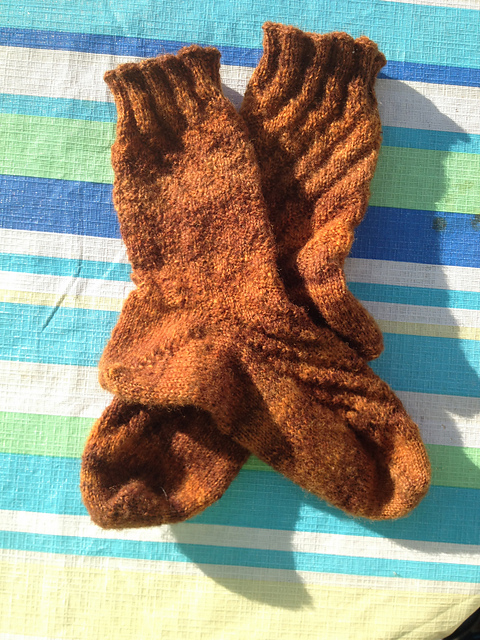
Time for a re-examination of some of my better handspun socks. I'll let you guys see the "before-and-after" photos. These are all socks that have held up well after at least a year of heavy use. My other handspun socks have mostly felted and/or shrunk and/or worn faster these, so I won't be using those fibers again. Yes, that includes UK Southdown...it wears fast.

Number 1: UK superwash BFL / nylon (70/30) blend

The yarn was spun very fine - 4 ply - since at the time I was really trying to reproduce commercial sock yarn. The yarn felt quite nice - quite comparable to a millspun yarn although a little tighter plied. I didn't go out of my way to knit them tight. These socks are by far the best of my handspun socks, in terms of longevity. They haven't felted appreciably, and there has been no need to darn them. The dye has faded in the laundry, over time. I would highly recommend this blend for those who don't want to agonize overmuch about TPI, grist, or knitting gauge. In fact, I'd recommend this blend to myself. Self: please get more of this stuff.

[superwash BFL/nylon before]

[superwash BFL/nylon after -
note fading but stitch definition still good. 2.5 yrs old.]


Number 2: UK shetland / mohair (70/30) blend

The yarn is 3-ply and very dense, not very thin though - heavy fingering/light sport. The yarn is rather different to knit - it has very little elasticity, and I knit it supertight, so the resulting fabric is probably not what people are used to in a sock. They're a bit stiff, smooth, and rather slippery. That's the mohair talking! They are very, very warm and comfy though. The socks have been darned once (they wore through at the toe very quickly) but since then have been performing well. They have felted and shrunk a tiny bit. This is a good blend for those who eschew the use of nylon and superwash.

[shetland/mohair blend, before]

[...and after. Minimal fading. 1 yr old.]

[there is felting on the inside, on all my handspun socks, 
but much less on the superwash ones]

Both fibers from number 1 and number 2 socks came from Hilltop Cloud, a favorite indie fiber dyer of mine. I'm pretty sure she uses UK-sourced fiber. She does not always carry sock blends. I love her sense of colour, and I keep an eye on her shop so I can order from her when she does carry my favorite blends.

Number 3: local Romney, 100% pure wool

The fiber is local, not UK Romney, and was pindrafted roving (not combed top), so these are true woolen spun socks (for those purists out there). Like the socks above, the yarn was dense, and I knit them at a tight gauge, so the socks were not as elastic as you'd get from a commercial sock yarn, but they were super warm. I loved them!! They were tough as nails, but now have started to wear out at the heel, and have been darned twice at the toe. They currently reside in my darning basket...

[local romney, before]

[...and after. 2 yrs old. Note fading and pilling, 
and you can see the darning spot on the heel...]

[...with more required!]

That gives me a pretty good choice of sock fibers to pick from! 

Of course, I'm still trying other fibers and blends...the fun never stops!


Monday, November 20, 2017

Chain or Navajo Plying

Sometimes - OK, for me, rarely - you want to maintain the striping nature of space-dyed roving. The usual technique is then that you use so-called "chain" or "navajo" plying, creating a three-ply yarn that maintains the colour sequence of the single, and produces a variegated yarn rather than  one that is"barber-poled".

Admission: my chain plying sucks. Mostly because I get no practise at it, since I'm not a big fan of self-striping yarns. But also because I suspect my technique simply isn't very good.

I recently came across an excellent video, that features Sarah Anderson showing you how she executes chain plying. It was a revelation to me. I tried doing it her way, and found that the positioning of her hands really helps the process. I used to pull out each loop before plying it, leading to a jerky, and hence uneven, plying job, but her way of doing it is much smoother and makes a better yarn.

One trick is that you need to have the right tension on your single. A tensioned kate is really indispensable here. You need a tension that will feed easily enough so that you don't break your single (it's a pain to deal with broken singles in this technique!) but not so loose that the loop in your chain goes all squirrely. I tried my cheap version of a tension box - weaving the single through the rails of a rail-back chair - but this is hard to make adjustments to once you're set up, so doesn't work as well at all.

In the video, it looks like Sarah is wearing a skirt, and her single comes from her right on the floor somewhere, but I find it easier to wear pants so I can feed the single up between my legs. That way my hands are naturally positioned in front of me, and they stay there.

Another tip is that chain plying does not "average" the thick/thin variations of your single well. On the contrary, it tends to emphasize irregularities! So if you want even yarn, then you need to be able to spin a nice, consistent single first.

The last tip is that I tend to overply using this technique - the hand motions required slow me down considerably - so I find that I need to do this on my slowest whorl, and treadle gently. This is hard for me to do, because I'm so used to speed (I usually spin and ply on my highest whorl, double-drive style). Perhaps if I practise this more, I can get faster...

Anyways, my first try after watching her video resulted in a much improved yarn. Still a bit overplied but clearly I'm getting better!

[slightly overplied, but much improved, chain plied yarn]


[here's what I made from it. You can see the self-striping in action.
pattern: slightly modded Kindness Shawl by Jaala Spiro, free on Ravelry]

This is now a technique that I'm willing to try more often!

Monday, July 3, 2017

Blended Fiber for socks

Now that I have some experience with single-breed handspun socks, I'm starting to want to branch out into fiber blends. Since I have no ability to blend fibers myself, I'm always on the lookout for suppliers who can sell me sock-friendly blends. My first forays will be into single-breeds with either nylon or mohair for strength.

So far, I've spun up a 70/30 shetland/mohair blend (from the UK) that has become a pair of socks that I am very happy with. The spun yarn (3 ply) had a nice sheen, but no bounce. The socks were knit at tight gauge. They developed a hole at the toe (my big toenail is a veritable saw) rather quickly, and have been darned, but the rest of the sock is, so far, wearing admirably. Comparable to my Romney socks.

[Shetland/mohair socks]

I have also spun and ruined a pair of 70/30 Finn/nylon socks - these felted very quickly. So no more Finn for me.

I have, laying around, some 70/30 Southdown/nylon as well, that is still waiting to be turned into socks. Yes, yes, I will get around to you!

And, I should mention one of my earliest forays into spinning for socks, a 70/30 superwash BFL/nylon blend that became a pair of socks for my husband, which have lasted 2 years so far with no signs of wear. I'll have to do a post on these so you can have a closer look at them (compare new and 2-year old photos), because so far, these are the strongest handspun socks I've made.

But here are some purchases that I made that I now have regrets about:

[70/30 (non-superwash) BFL/nylon blend]

[70/30 BFL/mohair blend]

I purchased them via the internet based on a description alone, which, it turns out, isn't enough. 

It's hard to see (particularly difficult in the second photo), but these blends are not actually blended enough for use in socks. The fiber is meant for decorative items. When the dyer ordered their raw material (from World of Wool, I suspect), they requested only 1 blending pass, so that there are still very visible "ropes" of nylon (emerald green streaks in the upper photo) or mohair (deep yellow, shiny, wavy locks to the right of my thumb in the lower) in the tops. I am afraid that this is not going to even itself out during spinning, so that the yarn will not have an even distribution of nylon in it. While this might be nice for a shimmery shawl, I'm not convinced it's useful for hard-wearing socks...I'll have to make a shawl or something out of these two!

So, lesson learned: I need to be sure that the blending is thoroughly done, and this is something I need to ask about, if I cannot see the product!


Monday, June 19, 2017

Socktacular Experiment, vol 2

Right. So a while back, I purchased a bunch of single-breed fleece "tasters" - 50g each - to spin into socks.

I've done 5 of the 7 by now, and it has been an interesting spinning experience. Here's a summary shot:

[top to bottom: Clun Forest, Romney, Texel, Southdown, Suffolk]

For starters, you can see that the colour "white" is quite different for each breed. The whitest is the Texel, which is really quite blinding. The Romney has a distinct yellow cast and the other three are rather close together - a greyish white, compared to the Texel.

Just to recall: these are all commercially prepped rovings (ie. carded, not even pindrafted) from the same mill. These are all classified as "medium wools", ie. not fine and soft like merino. The mill does not provide a micron count.

Here are my spinning notes so far, in order of my spinning them. They were all spun longdraw, true woolen style.

No.1 : Texel
Man, springy stuff! The fluffiest yarn I have ever spun, and I'm not sure it's suitable for socks. It is very fine, a little nebby, and the result is exceedlingly woolly and lightweight. It's very white and has no lustre at all - chalky white. I'd love to make a sweater out of this, it would be like wearing a cloud!
The yarn is underplied, so will have to go back through again before I knit anything with it. 

[Texel, up close. You can see it has too little ply for sock-use]


No.2 : Suffolk
This is an official downs breed, and is again springy, but not as blindingly white as the Texel. It feels coarser.  The roving was less nebby than the Texel, so an easier spin. 

No.3 : Clun Forest
I busted out the spinning oil on this one, just for fun. The first two didn't really need it, but I wanted to see if using it made any difference. The answer: not really (although I have had situations where a little spinning oil really helped!). This breed is definitely the coarsest so far, and feels almost wiry. I wound up spinning it a little on the heavy side. 

No.4 : Southdown
Very fine fiber. It's finer than the Texel and softer. Also, much nebbier than the others so much more work to spin. I did not enjoy this much, it was a lot of work. And I'm not convinced it'll be good for socks, without nylon...

No. 5 : Romney
OK, this is totally different stuff from the fiber I've spun up (mostly from the UK). It's about the same coarseness as the Clun Forest, and not as springy as the others. It has a very distinct yellow cast to it.

[Romney, close-up]

The last two are a Cotswold and a Dorset, which will be on the wheel shortly. Thereafter, the knitting starts!! Stay tuned.

Thursday, September 29, 2016

Socktacular Experiment

A while back (several months) I ordered a batch of "medium wool" single-breed rovings from a mill in Carstairs, Alberta. This isn't exactly a local mill - Carstairs is about 1000km away from me - but I thought I'd give Canadian sheep a try.

I was able to get a taster pack of 7 different breeds (all wool comes from SK, AB, and BC). The prep is carded ropes, not pindrafted. All the wool is white and I got 2oz (ie. 50g) of each - which is enough for a single sock. Heheheh...yep, I'm going to make 7 single socks, same spinning, plying, and knitting for each, embroidered with an ID marker, and then I'm gonna mix and match while wearing them. Ha. That should sort out the best breed, don't you think???

[taster pack of sock breeds]

[breed number 1 on the wheel]

The breeds I got are: texel, romney, dorset, cotswold, suffolk, clun forest, and southdown. As I said, all from Canadian sheep, and none of them bred for their fiber. Canadian sheep are mostly meat sheep, especially in commercial flocks (of which there are only few, Canada's not a big sheep country - too many predators). The mill I bought from is profit-driven and not a hobby or co-op operation, so they buy cheap fiber in bulk. They are not in the business of buying single fleeces from hobbyists.  The only trouble with buying roving from this mill is that the shipping is extremely expensive - thank you Canada Post. That means I won't be doing a lot of it. 

Anyways, I thought this might be a fun thing to try. Spinzilla is coming and this is going to be my project - see if I can get through a bunch of this roving. I've started on the Texel and it is a very different spinning experience from all the commercially combed prep I've been using - it's got a few blebs so takes some attention, but it's possible to spin fine, wooly singles. Man, are they wriggly! The Texel is extremely springy. I'm keen to compare the Canadian southdown with the stuff I've used from the UK. Also I 'm curious to see how the Romney fares, as that's my current favorite!

I'm aiming for 4-ply socks. We'll see if I'm able to do that - lately I've been slipping to 3-ply as I'm finding that the knitting makes a huge difference (as in: very tight gauge knitting can compensate for the lack of the 4th ply).

[ Texel single with commercial sock yarn as comparison]

I'll keep you all posted with how these spin. It'll be some time (as in, months!) before I can make any conclusions about how the socks wear...


Thursday, September 8, 2016

Sock Fiber Disaster

Yup, I do make mistakes. But that's how you learn, right?

I got some Finn fiber blended with 20% nylon (trilobal, I think, which is a bit sparkly) via a Ravelry group that is interested in trying different sock blends. I dyed it up myself using an iDye packet and spun it up and knit up some nice manly blue socks. They fit well and the initial products were pleasant and my husband wore them to work.

[Finn/nylon socks]

Then I washed them. 

Disaster.

After a mere 3 cycles through my usual laundry routine - which is, as loyal readers know, involves a Euro front-loader, delicate cycle, cold water, and air drying - they are completely and totally felted. A ruined mass of wool.


[felted socks]

[close-up of felted knitting]

Finn is a fairly fine wool, and in retrospect I should've known this would not be a happy choice. It is great for felting. Ergo, it is not great for socks, unless you're after slippers, I guess...

Lesson learned. No more Finn for me.

Tuesday, October 6, 2015

Mixing up Colours during Spinning

I love the colours I get in dyed tops. The artisans I buy from do a far better job of dyeing than I can do and they come up with some truly glorious combinations. But, usually I do not want to produce a self-striping yarn, I would prefer an "optically mixed" yarn. After long thought and reading I think I've finally figured out how to go from striped roving to non-striped yarn.

Most of the info on the InterWebz seems to cover techniques meant to keep the colour changes in the roving mostly intact. This includes things like "fractal spinning" and chain or navajo plying. I don't use these techniques much because this isn't the look I'm after. I don't want stripes.

To mix up the colours in your roving, I guess you could split it up into the coloured bits and run it through a drum carder...but a) this would destroy the beautiful combing job that the top has, and b) assumes you own said carding tool. I don't. So what to do?


[initial roving, space-dyed]

Enter "combination drafting".

step 1) split the top lengthwise into 8 long, thin strips. This is usually easier than it sounds, especially with commercially combed tops. Pindrafted stuff is harder to deal with, and won't split nicely, but you can still try this. Carded roving won't split this way at all, so you probably cannot use this technique.

step 2) tear these thin strips into shorter lengths, with different colours at the "head" of each striplet.

[roving separated into striplets]

step 3) pick 3 short strips and hold them together. Start spinning, drafting across the top of the 3 striplets to mix up the colours. You do this by drafting from one striplet for a while, and then you bring in another one by tilting or rotating you fiber hand to allow the single to touch the new striplet. This should "suck" it into the drafting zone and naturally lead to the drafting zone moving to the new striplet. You can help it along by pulling fiber from the new striplet, to feed into the drafing zone.

[hold 3 striplets and draft from each one in sequence]

In this way, you can control how much of each striplet to use before moving to the next one. In general the colour shifts will happen much, much faster than if you were to simply spin from the whole top. And because you can pick different colour sequences by choosing different striplets as you go, you break the colour sequence that the dyer established. You'll end up with a mixed-up single.

Then, when you ply, the more plies you use, the more mixed-up it gets. There's no "order" to the colours anymore, and you get a more "optically blended" look to the yarn.

Here's the finished yarn (3-ply) of the roving in the above photos. It's pretty blended; the real proof, however, is in the knitting.

[combination drafted 3-ply yarn]

Here's a photo of another skein that I did using this technique, knitted up. You'll see you still get striping, but the stripes are narrow and random.

 [combination drafted yarn, knit up]

I think this technique works really nicely for "tonally" dyed rovings, where the colours are from the same family and aren't too contrasting. It will have a more muddying effect on rovings that are dyed with high contrast colours (ex. rainbow-dyed).

Tuesday, September 1, 2015

Sock Fiber Review 4

More explorations of sock spinning...

1. Romney aka Marsh Romney aka Kent (Romney) : these sheep originated in the Romney marshes area along the southeastern coast of Britain, facing France. It's a long-wool breed, originally bred for the worsted wool market. The breed is excellently suited to damp conditions and was exported to New Zealand in the mid-1800's, where today it (and its crosses like Coopworths and Perendales) makes up the bulk of the sheep population there.  It also appears to be quite popular here on the we(s)t coast of Canada, so its fiber is available at local fiber fairs. This batch I got from the Cowichan Fiber Fair last fall, it was a carded roving (commercially prepped by a small local mill, I think) and dyed in nice autumnal colours. After my previous experiments with a cable-plied longwool (which I didn't enjoy), I did a straight 4-ply to mix up the colours as much as possible. The fiber does not feel as slippery as Border Leicester, but it is easy to spin fine. It feels very strong, but not elastic, which is what you expect from a longwool. Because of the carded prep, the yarn is fuzzy - not smooth.

[Romney Ram, photo courtesy of Wikipedia]

[4-ply Romney yarn]
 
 [Romney Socks!]

I knit up a pair of socks and these feel much nicer than the cable-plied Border Leicester ones I made a few months back. The knitting experience was more pleasant (more "give" to the yarn) and the resultant socks a bit more elastic - though not as springy as a downs breed! I'll have to give them some months to see how they wear compared to my downs breeds socks.

2. Jacob : these are funny little sheep, a "heritage" variety with more than 2 horns, and some can be "piebald" (multicoloured). Their history is obscure, but this is a very old breed - one of the old world's "landraces". They have recently played an interesting role in understanding the genetics of Tay-Sachs disease. The commercially combed top I got was very dark brown - a natural "black". It's rather coarse - scratchier than the downs breeds I've tried - has very little lanolin, and is crimpy - not as crimpy as southdown, but still produces a nice springy yarn. The combed top I got was easy to spin fine. I plied it for a 3-ply cable or crepe construction, with a single ply of shetland - dyed pink - to make a 30/70 shetland/jacob marled yarn. The yarn fluffed out a lot to make a very poofy skein. This wasn't a very tight ply, so I will knit the heels and toes using millspun sock yarn with nylon, or I'm pretty sure they'll wear out within a few months. But this is a nice breed to experiment with.

[jacob sheep]

[3-ply crepe or cable plied jacob/shetland yarn]

Saturday, August 1, 2015

Ply Twist and Yarn Thickness

OK, so I recently spun up some Southdown, which, although I really like its springiness, I'm starting to think is really too fine for socks. I've had poor wear with the 2 pairs of Southdown socks I've made so far, one done in a supposedly hard-wearing cable ply.  So now I'm about to do a few Southdown experiments:

1. add more twist to my plying job: run my finished yarn through the wheel again to give it more ply twist (and see what this does to the diameter and "feel" of the yarn).

Here are some "before and after" photos. By running the yarn - quickly - through the wheel again, I managed to go from 16 twists per inch to about 20 TPI, which is I think the limit of the amount of twist to have. The yarn shrank in diameter a bit, although it's hard to tell because it's not a very even spinning job and I didn't measure the same piece of yarn "before and after". But my impression is that I moved from about 10-12 WPI to about 12-14 WPI. The replied skein was squirrely and twisty, but the new twist set in the soak and it now hangs straight once again. The yarn is a little harder, but still quite squooshy. Southdown can handle a lot of twist - much more than Cheviot or Suffolk, I'm seeing now. I've recently tried plying Cheviot at 20 TPI and it's a lot harder. Suffolk cable-plied at 14 TPI is basically string.

[10-12 wpi, 16 tpi before replying]

[a little tighter and 20 tpi after replying]


2. ply in some nylon: I have some wooly nylon from my serger, and I'll ply that together with about 5 g of my finished yarn at the same time as I'm "up-plying" it.

Here's a photo  of the finished yarn. The wooly nylon is very elastic and thin. Plying was actually a royal pain to do, because both the diameter and elasticity of the nylon and the 4-ply yarn are wildly different. So it's very difficult to ply the nylon in evenly. It's pretty clear that adding nylon in this way is a poor second choice to blending nylon fibers in at the roving level! I don't think I will be repeating this experiment. It's quite likely more effective - as well as easier - to just knit in some reinforcement thread.

[wooly serger nylon plied into 4-ply yarn]

3. add nylon to the top: I managed to convince a group of fellow spinners to split a batch of custom-blended Southdown with nylon added in! By the mill's advice, it'll have 20% nylon, which is about what commerically-spun sock yarn has, so I'm betting that this blend will be very hard-wearing no matter how it's spun or plied. For wool purists, though, this sure feels like a cop-out...but I'm happy to be able to get my hands on some fiber that I'm pretty sure will make hard-wearing socks!

Wednesday, July 15, 2015

Back to Basics - Twist Control

In an effort to improve the longevity of my handspun 100% wool socks, I want to increase the amount of twist I put into the yarn.  But how can I be rigidly sure that I'm getting the correct twist, consistently? Time for some more of my favourite: discipline!

Here's what I'm doing: I put 2 pins in my spinning apron (an old towel) that are 2" apart, exactly. I set up my wheel on the 14:1 whorl, and then as I spin, I carefully draft out 2" of roving between the pins for one treadle, and move my hand back to the roving during the 2nd treadle. So: 2 treadles for every 2" drafted. This is a classic short forward draw, to produce worsted singles. At this whorl ratio, that means I'm getting 14 tpi (twists per inch). If I chose my 10:1 whorl, I'd get 10 tpi in this way. As long as I am careful about drafting between the pins every time, and holding to the rhythm, I'll get consistent yarn. I'm aiming for a single that's the thickness of buttonhole thread.

[use pins to control how much I draft per treadle]

I'm pretty sure that this is more twist than I've habitually been putting in; I'm guessing that I used to be more in the 10 tpi neighbourhood, perhaps even lower, as I gravitated towards backwards long-draw in the hunt for speed. I can tell by the feel of the single - it's twistier and quite a bit harder than I'm used to feeling.

I'm finding that 2" is a comfortable amount to draft out of this fiber (Suffolk). I tried doing 3" (that way, I'd get 28 twists over 3" or a tpi of about 9), but this was hard to keep consistent as the natural fiber length of this Suffolk doesn't lend itself to larger bites of roving. I'm guessing that this is a variable you have to play with, depending on the roving you are spinning. I also find myself lapsing into long-draw as my attention wanders, but then I have to snap myself back into the forward draw to really fixate on the twist. Did I mention discipline already? This is slow, tedious work, so you need to get into the Zen of it.

For plying - I'm doing a 4-ply cable here - I use the same pins, overplying by a factor of 2. So: 4 treadles for these 2". I'm using the pins to keep myself on track! This is even slower than the spinning! Then on the final ply, the yarn just snaps into place without me really concentrating very much.

A small sample so far looks like this - quite tight, and the yarn with less spring than I've been getting with my usual long-draw technique from downs breeds (I think the cable-plying and the tight twist "eat up" the inherent springiness of the fiber). The yarn is very dense; although this test sample is quite fine wpi-wise, the grist is lower than I expected.  I don't think I'd try 14tpi with a longwool, and certainly not a cable-ply at this level of twist... The yarn is harder than I usually produce, and I'm wondering if it isn't actually too harsh...I will have to knit it up to see.

[sampling: 18-20 WPI and a grist of 2600m/kg]

A by-product of the back-to-basics exercise is that I'm developing a sense of what high-tpi singles feel like. As I get better at this, hopefully I'll be able to advance to spinning longdraw, using higher-speed ratios - a faster way to spin - without losing the tpi. 

Wednesday, July 1, 2015

Clockwise or Counter?

I always get confused about "Z" and "S" twist. I find it easier to think about clockwise and counterclockwise. (For the record, Z = clockwise, S = counterclockwise. For a variety of physics-induced reasons upon which I will not elaborate, I reverse these constantly. Best to stick with the clock analogy...).

Anyways, from my own experience in knitting both "continental" and "british" styles (aka "picking" and "throwing"), I find that I, personally, need my yarns to be plied counterclockwise. Otherwise, no matter how I knit, the yarn unplies, which is super annoying. This single factor overrides all other considerations for me, so I've not intentionally played with plying direction, and I certainly haven't compared plying direction and stitch definition (like this article explores). Other knitters find that their throwing and picking styles seem to require opposite plying directions, but I don't find this. Since I don't crochet (willingly), I haven't explored if my crocheting style requires a different plying direction from my knitting.

Anyways. For me, I know that my final ply must always be counterclockwise. This means that for regular plied yarns, I spin my singles clockwise and ply counterclockwise.

For standard 4-ply cable yarns, which I do a lot of, there's an extra plying step involved, so my singles must be spun counterclockwise, then plied twice: first clockwise, finally counterclockwise. This is where I've made mistakes - starting off spinning clockwise, and ending up with clockwise-plied cable yarn, which unplies as I knit. Lesson learned!

For 3-ply cable yarn (or crepe yarn), some of the singles must be spun clockwise, and some, counterclockwise. Yes, it gets complicated! I label the bobbin, marking the spin direction, if I'm making this type of yarn, so I don't mix them up!

So the lesson here is that I need to decide in advance what my final yarn is going to be, before starting to spin. It also means that by now, I can spin clockwise or counterclockwise with equal ease, with very similar results in terms of uniformity and twist. I think maybe that's why spinning for socks is such good training! It really has led me into learning about all these techniques and has improved my spinning skillz!


Wednesday, June 3, 2015

Directionality

I recently bought some very soft fiber for a non-sock project, it was D'Arles Merino. This is one of 20 merino types (breeds), with a fine fiber (20 microns -which is to be compared with around 30 for the downs breeds I typically favour for socks) and still available in non-white natural colours. D'Arles Merinos originate from the south of France (as Spanish merinos were crossed with some local breed) and are suited to the hot, dry climate there. The sheep are apparently watched over by human shepherds, still, and they spend the hot summers high up on the southern massif, where there's still grass to be had once the plains dry up. A few years ago I visited the Lozere and the Tarn Gorge, and, during our 3-day hike there - on ancient drover's or sheepherding trails -  we actually witnessed a shepherd and his flock. I don't know if those sheep were merinos, or the local sheep whose milk goes into the famous Roquefort cheese, but it was interesting to see real shepherding still being practised!

Anyways. This fiber is very, very soft (hence I wouldn't make socks using it!!) and when I tried to spin it, it was extremely difficult to draft. It wasn't felted, but certainly seemed to love to stick together. I tried pre-drafting (something I normally never find necessary with commercially combed tops) and even then, could only produce lumpy singles. In desperation I turned to the Ravelry forums and asked for help, where the prompt suggestion was to turn the braid around and spin from the other end.

Wow. What a difference! This was still not the easiest of fibers to spin, but once I started drafting in what turned out to be the "natural direction" of the fibers, it was much, much easier and I was able to produce non-lumpy yarn.

 [DK weight handspun, chain-plied, D'Arles Merino, super soft!]

In retrospect, this isn't surprising, since wool has little scales that are responsible for the grippiness that makes it felt (and also repel water and dirt). The more scales, the more the stuff will felt. The modern "superwash" process does something to the scales (abrades them or fills them in) to prevent felting, so I'd imagine superwash fiber to have very little directionality. If you're careful, you can tell the directionality by petting - like you'd do with a cat - combed fiber (carded roving is jumbled, so not directional), but this was pretty subtle on the commercial top I had.

 [electron microscope image of wool fibers, image from Vogue Knitting (1989 edition)]

I've since tried to discover which other breeds might be prone to this directionality. I've read that longwools can be - BFL, Wensleydale - but I've not encountered directionality in my (limited) spinning of these, so far.

But at least now I know what to do, the next time I encounter this problem!

Friday, May 1, 2015

Sock Fiber Review - 3

More fibres I've tried for socks...
 
Polypay

 [polypay sheep]

This is a "modern" dual-purpose breed of sheep, developed in the US in the 1970's. It's a mix of Finnsheep, Dorset, Rambouillet, and Targhee. The roving I got was from a lamb (ie. its first clip!) and therefore probably finer than what an adult sheep would provide, although Polypay sheep are bred to produce "fine" wool. It's commercially combed top, very springy, and reminds me of Southdown - but much finer. It's quite easy to spin. I did a 4-ply cable ply because I'm not convinced that this very fine fiber is going to be as long-lasting as some of the coarser fibers I've been spinning.The resulting yarn is soft, elastic, and very poofy. Now that I'm done with it, I think it's not suitable for socks, it's just so soft! Perhaps adult polypay fleece is stronger, but this is not going to be knit into socks! In fact, I knit a shawl with it, which turned out "meh" - didn't drape as well as I'd like. Very soft, but because of the boing factor, probably best suited to hats, mittens, and casual sweaters.

[ polypay lamb fingering, 4-ply cable-ply ]

Exmoor Blueface

[exmoor blueface sheep]

This fiber I got from my favourite Etsy shop in the UK and is also available here. The sheep - called "mules" - are from an Exmoor Horn ewe and a BFL sire (read my post on sheep breeding for more about mules), and they come from the Exmoor area in Britain (which isn't very big),  in the bottom left hand corner of the country. The Exmoor area been part of the wool trade for centuries, with a variety of breeds (Exmoor, Dartmoor and Cheviot) grazing the "moors" or high, treeless hills. I looked up Exmoor Horn sheep in my copy of The Fleece and Fiber Sourcebook, and it appears these are meat sheep, not really known for their fiber.  What I got is long-stapled and not as crimpy as the downs breeds, although much curlier and crisper than the Border Leceister and BFL I've tried. It's not as fine as BFL, so I'm thinking it'll be harder wearing. The yarn is definitely more elastic than the Border Leceister - and also the BFL- but not as springy as Southdown. So far the socks are knitting up very nicely, they are cushy and elastic. I'm really liking this. Definitely a breed to add to the sock repertoire!

 [ exmoor blueface sock yarn, 4-ply cable-ply ]

I've been able to get my hands on some 40/60 Exmoor Blueface / Zwartbles blend (thank you HilltopCloud!) and this has also been very nice to work with.  This is a bit coarser and tougher than the Exmoor Blueface above, but it makes lovely hiking socks. Again, something to add to the repertoire.

[ exmoor blueface / zwartbles blend socks, 3-ply chained ]


So far, I've been enjoying my experiments with these dual-purpose breed fibres. It's very elastic "out of the box" and I really enjoy knitting with it. I've not been successful in getting dress-sock grist with this stuff yet (still trying!) but the hiking socks I've knit up feel indestructible!

**update** the  Exmoor/Zwartbles blend (I've used this 2x now, still loving how it spins and knits up!) is prone to felting. It's probably best hand-washed. Sadly, since I refuse to handwash laundry items (maybe in my retirement I will find the time for this activity?), this blend is going to have to come off my list of useful sock fibers...

Wednesday, April 22, 2015

Sock Fiber Review - 2

I am trying to make at least half of the socks I knit using my own handspun. This forces me to practise spinning-for-socks, and also means I get to experiment with a few different breeds.

Last time, I reviewed 2 different "downs" breeds, which are really famous for sock fiber: I tried Southdown and Dorset. Other "downs" breeds include:
  • Oxford Down
  • Hampshire (Down)
  • Suffolk
  • Shropshire
Downs wool is short-stapled (doesn't grow very long) and very curly. The sheep originate in the hills of southern England and have been used to produce quite a few different "crossbreeds". Some of these breeds are quite common in North America - they are "meat" sheep. Here in Canada, you might find fiber from (Rideau) Arcott and Polypay breeds, which are relatively new and have downs-type wool. I know the Custom Woolen Mills sells fiber from these sheep.

Anyways, for this set of sock fiber trials, I spun up some "long" wools. This type of wool is quite different from the downs breeds, it isn't nearly as springy and so doesn't produce an elastic yarn. It is much shinier than downs wool. Longwool-type breeds include:
  • Border Leicester
  • Wensleydale
  • Teeswater
  • Romney

Border Leicester

[Border Leicester sheep. Love the ears!]

This breed is originally from Northumberland in northern England. It's also classified as a dual purpose sheep (meat/fiber).  The fiber is available in either white, or brown - the latter especially if you buy it from smaller outfits. The batch I purchased was from a local Gulf Island farm, and was commercially carded (not combed) - kind of unusual for a longwool (which one would expect to find combed). The prep wasn't very good - quite "nebby" (lots of little knots, or pills, in it) - but despite this I found it much easier to spin that the downs breeds. I managed a 4-ply (cable-plied). The yarn is very fluffy and not elastic at all. Other longwools I have spun exhibit a mohair-like "halo", even when spun worsted, but in this case I think the fuzziness was enhanced by the fact that the wool was carded (not combed). I stuck to a plain 2x2 rib in order to keep the sock as elastic as possible, and resulting socks are very fuzzy, not very stretchy or bouncy, and feel more like slippers than socks. Bottom line: I'm sure they'll wear like iron, but I'm not in love with the lack of elasticity I'm getting. Not a repeater for me, for socks, anyways. 

 [ border leicester socks ]

Blue-Faced Leicester ("BFL")

[BFL sheep with classic "roman" nose]

This is a breed that is becoming more popular in the yarn shops. Most knitters will have heard of "merino" wool, and now the latest thing is "BFL". As the name suggests, these sheep are related to the Border Leicester breed. They look similar and their wool is also long-stapled and shiny, and is available in natural brown and white. It's becoming popular for sock blends - typically in a "superwash / nylon" blend, which is what I spun up. Thanks to the very even prep (commercial combed "tops") and the superwash treatment, it's very, very easy to draft. Spinning fine is no trouble with this stuff. It comes out slightly shiny. The yarn is softer than the downs-type yarn, and not as elastic. The fact that they've put nylon in this fiber tells me that it is not as hard-wearing as downswool. I did a straight-up 4-ply, which came out very fine, rather shiny and very smooth, thanks to the commercial prep. The yarn is not very elastic, but because I used a tight ply it is more springy than the carded Border Leicester I spun up for the review above. This makes it more pleasant to knit.

[ BFL sock yarn, 4-ply ]

 [...and the finished dress socks!]

So I think my learnings from these experiments are that for longwools, I prefer to:

1. use a combed, not carded, prep - commercially-prepped "tops" are much easier to deal with and will give a nice, smooth, shiny yarn. This seems to exclude a lot of locally-processed stuff, though, because what I've seen at local fairs appears to be carded.

2. spin straight-up 3- or 4-ply with a tight ply to give extra "boing" to the yarn. A cable-ply doesn't seem as springy...

I haven't done enough wearing of my socks yet to know if the superwash and/or nylon is a "must" on longwool socks. I can see more experiments in my future!